Before Dracula
If you asked most people to name the first vampire that comes to mind, most would say Dracula – the Transylvanian aristocrat who took the world by storm in 1897 and has seen many reiterations and revivals of his character in the one hundred plus years since his birth. But what many people don’t know is that Dracula is not the first literary vampire to rise from the dead.
The Vampyre (1819), published almost 80 years before Dracula, is often considered the first modern vampire story. In it, the vampire Lord Ruthven is a suave British nobleman, and chiefly, friend and travel companion of the innocent and naïve orphan Aubrey. In Carmilla (1872), we see a female vampire take the literary stage for the first time who is obsessed with her friend and prey Laura.
What Dracula, Carmilla, and Lord Ruthven have in common – despite their varying levels of notoriety – is their class. Unlike the vampires of European folktales who were friends, family, and loved ones – often poor, reflecting the class of their community – the literary vampires of old were wealthy and strangers. They appear center stage, having unknown origins, and enchant the main character who may be befriended, preyed on, or both.
The Gothic Vampire
Lord Ruthven: Aristocratic Corruption
Lord Ruthven is the original Byronic vampire. An aristocrat who often gives charity, not to the virtuous, but to the profligate wanting to sink further into sin. Anyone who receives charity from him ends up “either led to the scaffold, or sunk to the lowest and the most abject misery”. Lord Ruthven takes great pleasure in corrupting the innocent and further damning the damned, targeting virtuous women, fathers with numerous children, and promising young men. The young Aubrey (inspired by Polidori himself) who has been observing his companion this whole time is flabbergasted and appalled by his behavior and decides to part ways.
Lord Ruthven was inspired by Lord Byron – a contentious figure in his time – known for his gambling, womanizing, and infidelity. Polidori and Byron were travel companions in 1816, but they had a falling out which lasted until Polidori’s death in 1821. Thus, Lord Ruthven can be said to be a critique of the aristocratic class of early 19th century Britain and the licentious nature of people like Lord Byron.
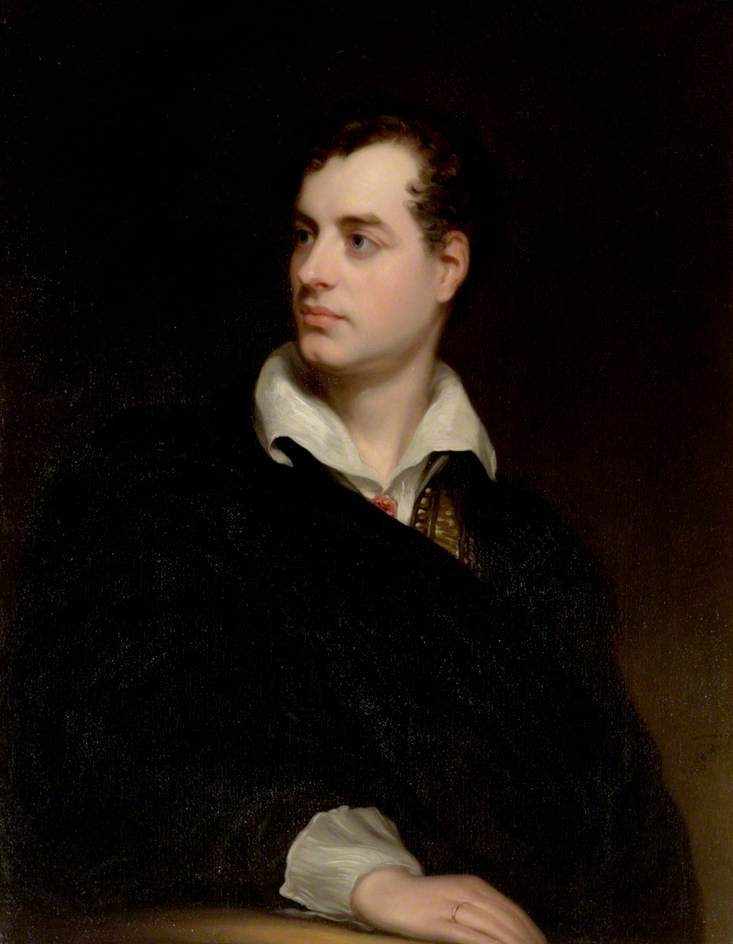
But Lord Ruthven represents more than a falling out between two former acquaintances – he represents a real anxiety felt by the emergent British middle-class. Aubrey was at first mesmerized by Lord Ruthven, forming him into “the hero of a romance,” and was not the only one. Lord Ruthven was eagerly welcomed into the social circles of the upper class. But as their journey continues and Lord Ruthven takes the mask off of his victims, forcing them to behave in ways anti-thetical to British society at the time, the horror mounts. Lord Ruthven is terrifying precisely because he possesses the privileges of the aristocracy while behaving without the moral constraints expected of respectable society. And what heightens this terror is that he already exists within society. He is a monster from within. And he can use his power and privilege to keep Aubrey from exposing his secret while his victim pile only grows larger.
Carmilla by Sheridan Le Fanu – Female Desire and Transgression
Carmilla represents a transgression of a totally different kind – sapphic desire. Laura is young and motherless, living with her father and a few maids. She lives a quite solitary life until the arrival of Carmilla (who has appeared to her in her dreams as a child).
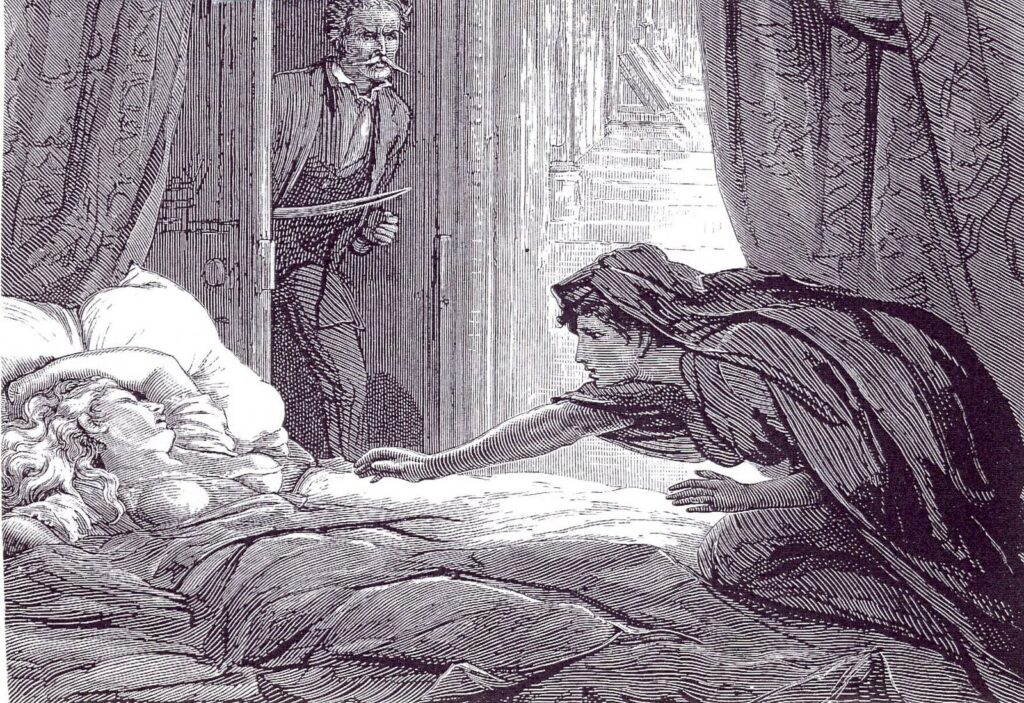
Carmilla is languid and beautiful, quickly enchanting the young Laura, “I wonder whether you feel as strangely drawn towards me as I do to you; I have never had a friend—shall I find one now?” Their relationship soon becomes emotionally and physically charged with Carmilla showering Laura in passionate declarations of affection, giving her soft kisses and caresses. Laura, however, struggles to understand her own feelings towards Carmilla.
Carmilla acts as a foil to Laura. She is self-assured, acts of her own volition, and shirks authority unlike Laura is meek, timid, and dutifully obeys her father. The charged relationship between them goes unnoticed by Laura’s oblivious father while at the same time Laura’s health begins to suffer.
Carmilla frustrates both gender and sexual categories which Laura tries her hardest to understand her behavior. She theorizes that Carmilla is secretly a “boyish lover” in disguise before quickly shooting the idea down. She then applies her (limited) understanding of “masculine gallantry” and female behavior to try to categorize Carmilla, who does not fit neatly into Victorian ideals regarding gendered behavior. However, Carmilla remains undefined, embodying both “male” and “female” characteristics.
Despite this, it seems that Carmilla has something to say about her own nature. Upon discussing a recent string of vampire-related deaths, she says “this disease that invades the country is natural. Nature. All things proceed from Nature—don’t they? Thus, Carmilla posits herself as part of the natural order, despite what many people would think.
What is frightening about Carmilla is not that she is a female vampire, but that she refuses to abide by the constraints of respectable Victorian femininity – meek, obedient, heterosexual. Instead, she confidently breaks conventions and posits that her behavior and her very nature is natural – one reason Carmilla has become such a compelling figure for modern queer readers.
Dracula: The Foreign Other
The most notorious vampire of all – Dracula – is a vampire apart. Unlike Lord Ruthven and Carmilla, he does not attempt to befriend the main character, providing intimacy and companionship. When Harker travels to Transylvania to finalize legal documents for Count Dracula, he has numerous strange and preternatural encounters in the Transylvanian countryside that leave him distraught. His arrival at the Count’s castle does nothing to assuage his anxieties and the stark contrast between himself and the Count is amplified. “We are in Transylvania; and Transylvania is not England. Our ways are not your ways.” As the novel progresses, Dracula makes it clear that he wants to conquer Harker and England as a whole. “Your girls that you all love are mine already; and through them you and others shall yet be mine.” He makes numerous comments about his origins (which are left ambiguous) and its violent nature. “Is it a wonder that we were a conquering race.”
Dracula was written during the decline of the British Empire, and this decline was often reflected in Victorian literature (e.g. The War of the Worlds and The Time Machine by H.G. Wells, The Mark of the Beast by Rudyard Kipling, etc.). Arata argues that Dracula presents the “pervasive narrative of decline, a narrative of reverse colonization.” (Arata 623). In his analysis, Dracula is a ghastly mirror of the British empire, gaining intellectual mastery of a foreign (English) culture before traveling to its capital (London) and gaining physical mastery over Harker and his companions.
Dracula was not simply a monster created to entertain the masses; he was a manifestation of a deeper cultural anxiety about empire, foreignness, and decline. And what made him even scarier is that he reflected the British consciousness back onto itself. Dracula was a response to the question, what if this happened to us?
Why Were Early Literary Vampires So Different?
Dracula, Lord Ruthven, and Carmilla are more than just terrifying bloodsuckers. They are preternatural beings that embody a threat to the boundaries of respectable society. The vampires of European folklore were frightening partially because they were members of the community, often someone you knew intimately. And as reanimated corpses they had a dreadful appearance (bloated, foul-smelling, cold to the touch). The 19th century literary vampire transforms that relationship, and vampires become wealthy, powerful, mysterious, foreign, and seductive. The vampire became someone you didn’t know but might nevertheless invite into your life. And that can be just as scary.
Vampires in literature are neither fully inside nor outside society. They exist at the boundary between (seemingly) rigid categories: living/dead, male/female, human/monster, attractive/repulsive. Ruthven, Carmilla, and Dracula each embody different threats to social order by straddling the line between these categories.
Ruthven represents the fear of corruption from within. He is already part of respectable society and is wealthy and socially connected. His victims don’t necessarily recognize him as a monster until it’s too late.
Carmilla represents the fear of transgression of social boundaries. She’s not frightening simply because she’s a vampire, but because she doesn’t behave according to the gender and sexual expectations surrounding her.
Dracula represents the fear of the foreign Other entering the social body. He comes from elsewhere and explicitly seeks to penetrate England and exert power over it.
What is remarkable about the vampire is how adaptable it is. The monster itself stays relatively consistent – an immortal being who feeds on the living, but what makes the vampire particularly frightening changes depending on the social anxieties of the time.
Conclusion
Vampires have changed much since the 19th century. Where before they were strangers from a strange land, intent on corrupting and draining the life of innocent people, vampires are complex, multi-faceted, and just like us. When and how did vampires change from monster to friend? I’ll explore this in my next part of The Vampire Archives “Evolution of the Vampire in Literature”.
Previously in the Vampire Archives
In my first post of the Vampire Archives, I discussed the folkloric origin of vampires. Read it here: Before Dracula: The Origins of the Vampire
For an overview of the Vampire Archives series and what to expect, check out my introductory post here: The Vampire Archives: An Introduction to My Vampire Literature Curriculum.
Resources
Gothic Images of Race in Nineteenth-Century Britain by H. L. Malchow
The Occidental Tourist: Dracula and the Anxiety of Reverse Colonization by Stephen D. Arata
Our Vampires, Ourselves by Nina Auerbach
The Vampire in Nineteenth-Century Literature by Brooke Cameron and Lara Karpenko
The Gothic Other: Racial and Social Constructions in the Literary Imagination by Ruth Bienstock and Douglas L. Howard