June is a dangerously beautiful month. Flowers are in full bloom, the days stretch past 8pm, and my favorite summer fruit – strawberries – finally return. Summer is the season when it feels like anything is possible. As the month has progressed, I’ve felt my anxiety gradually slip away. If contentment is something worth striving for, June is when it feels within reach.
June is also a month of reflection. Sitting at the halfway point of the year, it’s when I like to take stock of everything that’s happened so far. What were the highs? The lows? What have I accomplished, and where have I fallen short? But June isn’t only about looking back, it’s also about looking ahead. Despite the long evenings spent with friends and margaritas enjoyed on sunny patios, summer always passes too quickly. Before long, the days begin to shorten, and the air starts to cool. How do you want to spend the rest of the year? And if you’ve drifted off course, now is the perfect time to recalibrate and begin again.
Novels
Translated by: Nicole d’Amonville Alegría | Original language: Catalan
Genre: Contemporary | Queer
Rating: 4/5 stars
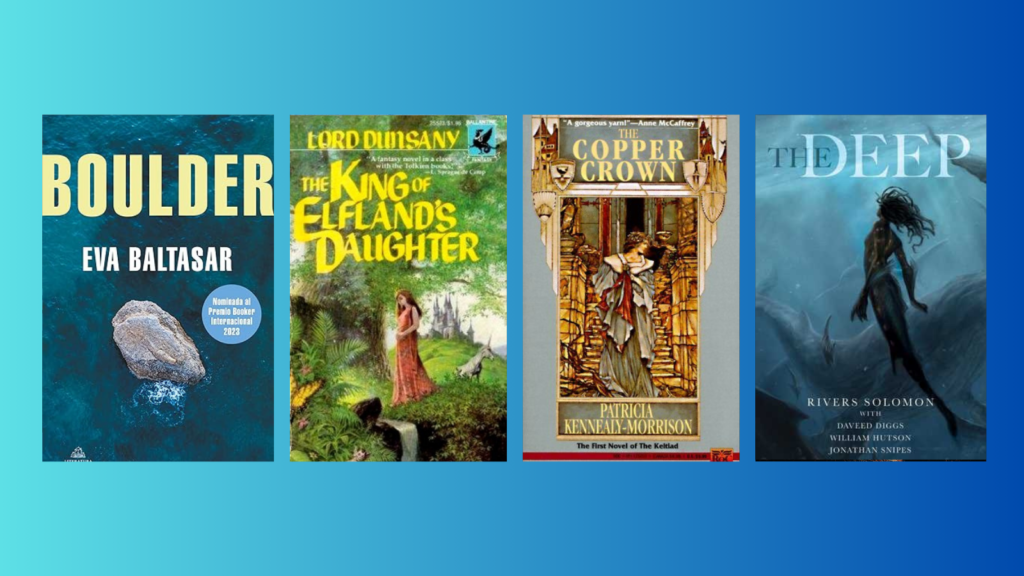
Boulder by Eva Baltasar immediately draws you in with its dark and magnetic prose. The novel follows a woman nicknamed Boulder, a cook on a merchant ship who revels in solitude until her lover, Samsa, convinces her to settle down with her in Iceland. Cracks in their seemingly idyllic relationship appear early on, but they are thrust to the forefront when Samsa announces that she wants to get pregnant – a concept completely inimical to Boulder, who has little affinity for children.
Motherhood is the central theme anchoring the internal and external conflict of the novel. While Samsa feels at home in the domestic life she has perfectly cultivated for herself, Boulder feels adrift and cast away. The distance between the two women grows until it reaches its zenith forcing Boulder to confront her desires and reclaim control of her life.
Boulder is a brief novel, but its exploration of desire, freedom, and motherhood lingers long after the final page.
Read my full review here: Boulder by Eva Baltasar Review: A Poetic Exploration of Motherhood and Freedom
The King of Elfland’s Daughter by Lord Dunsany
Genre: Fantasy
Rating: 3.75/5 stars
Considered one of the first fantasy novels, The Lord of Elfland’s Daughter follows the heartbreaking story of a marriage between a mortal man and an elf princess. Their relationship is fraught with cultural misunderstandings and tensions as the man tries to mold his elven wife into the image of a dutiful human wife.
Reading this book was like stepping into a fairytale. The prose—poetic and ethereal—pulls you into a dreamy world where magic is just around the corner, “past the fields we know.” Dunsany invokes the sublime not only in Elfland, where unicorns, elves, and trolls abound, but also in the land of man. The elven princess seeks the mortal world because of its beauty and the constant changes it undergoes every second of the day; time does not pass in Elfland. Even the trolls delight in the stars, pigeons, and countless other things that most people fail to see the magic in. This felt like a bedtime story my mother would have read to me on stuffy summer nights.
That said, this reads more like a legend than a modern fantasy novel. It contains very little dialogue, relies heavily on repetition, lingers in description, and allows the plot to inch forward at a snail’s pace. I wouldn’t recommend it to readers who prefer fast-paced stories full of action or who dislike flowery prose. But for those willing to surrender to its dreamlike rhythm, there’s something undeniably enchanting about it.
The Copper Crown (The Tales of Aeron #1) by Patricia Kennealy-Morrison
Genre: Science-Fiction (Space Opera)
Rating: 4.25/5 stars
I picked up this book and its two sequels at a library book sale for $1 each because I was completely captivated by their covers. The Copper Crown begins as a space opera before quickly venturing into fantasy territory. Humans searching for life beyond Earth discover the planet Keltia, home to a race of isolated superhumans whose culture is heavily inspired by Celtic Ireland.
The story is packed with political intrigue and betrayal, and I appreciated how varied the antagonists were in their motivations and ambitions. However, I found some of the characters—particularly the Kelts—a bit flat at times. With one notable exception, they are almost uniformly brave, strong, and loyal. There is very little interpersonal conflict among them, especially within the main cast, which made some relationships feel less dynamic.
I also felt that Keltic culture was somewhat idealized. I would have liked to see more tension between the Terrans and the Kelts, beyond the brief moments when cultural misunderstandings surfaced, such as Haruko’s assumption that the Kelts lived under a theocracy.
Despite these criticisms, the prose is beautiful and the world is intriguing enough that I’m eager to continue with the series.
Genre: Fantasy
Rating: 4/5 stars
A story about Black mermaids who are the descendants of enslaved women thrown overboard during the transatlantic slave trade—the premise alone drew me in. I found the book’s exploration of history, pain, memory, and the burden of the past to be deeply thought-provoking, even if some of its ideas were not entirely new. Solomon weaves these themes into the lives of human-fish hybrids in a way that feels both imaginative and emotionally resonant.
That said, I gave this book 4 stars rather than 5. The main character was not particularly likable, though I’ve found that to be a recurring feature of Rivers Solomon’s work. I also wanted much more time with this community. Solomon has created such a fascinating world, yet the novella is barely 150 pages long. At times, it was difficult to follow whose point of view we were in, and the ending felt a little too neat given the complexity of the issues the story raises.
Still, the prose is beautiful, and I enjoyed reading it. The Deep is a haunting and memorable novella that uses speculative fiction to explore the weight of collective memory and what it means to carry—or release—the pain of the past.
Genre: Gothic | Horror
Rating: 3.5/5 stars
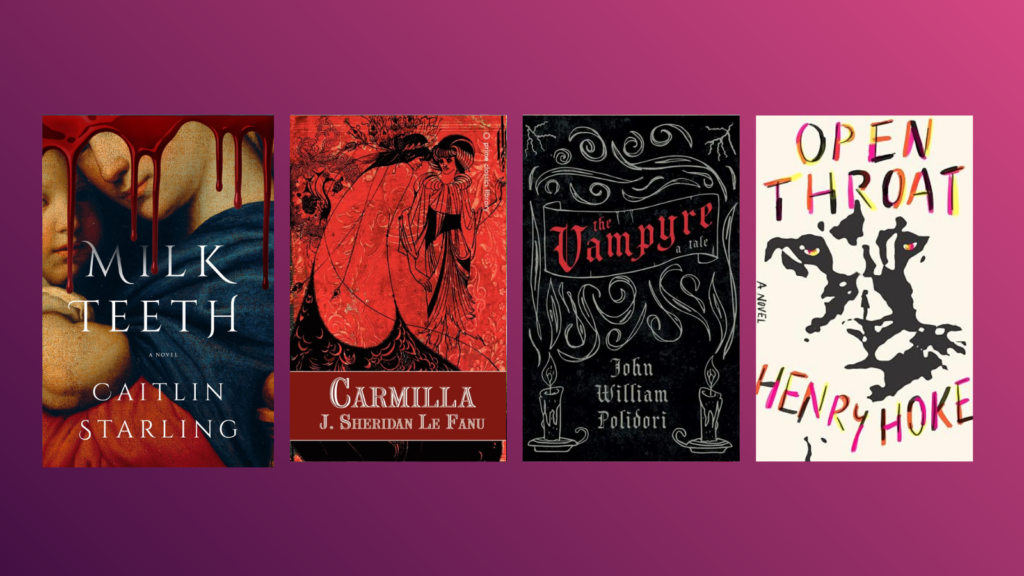
Milkteeth does something completely new with the vampire genre, using vampirism to explore motherhood, labor, and bodily autonomy through a vampire brood mother. Told from the perspective of Beatrice, one of the few vampire brood mothers, Caitlin Starling shows the marginalized position that nursemaids have occupied historically, showing the exacting nature of being forced into such a position where you are overworked and undervalued for something that your body can do.
My lower-than-expected rating comes down to the weakness of the prose, repetitiveness of the narration, and some weaknesses in the plot. However, Starling presents vampires in a novel way, and I do think that the allegories for womanhood and motherhood were strong. Starling is also great at creating a creepy and gruesome atmosphere with her writing. If any of this sounds interesting to you, then you should definitely pick up this book when it is published on October 20, 2026, just in time for spooky season.
Read my full review here: Milkteeth by Caitlin Starling: Book Review
Carmilla by J. Sheridan Le Fanu
Genre: Gothic
Rating: 3.5/5 stars
Another of the original vampire novels, Carmilla –which predates Dracula –takes a somewhat different, sapphic turn. Laura lives in an isolated castle with her father until one night, a horse-drawn carriage carrying Carmilla crashes nearby. Laura and her father agree to take care of the beautiful Carmilla until she is in better health and what follows can only be described as the development of a feverish and intoxicating friendship between the two girls.
Personally, I enjoyed Carmilla more than Dracula, which seems rather dry in comparison. At the time that Carmilla was written, homosexuality was considered deviant behavior comparable to sickness. And in the story, our heroine Laura does fall ill under the intoxicating nature of Carmilla’s affections (and blood-sucking). However, there are many modern queer readers who are reimagining the text through a sapphic lens. Overall, Carmilla is a must-read for lovers of Gothic fiction and vampires. This classic novella is somehow just as vibrant today as when it was published in 1872.
The Vampyre by John William Polidori
Genre: Gothic
Rating: 2.5/5 stars
Considered the first vampire novel, The Vampyre follows a wealthy young gentleman Aubrey on a road-trip with the suave British nobleman Lord Ruthven (based on Lord Byron). As the two men travel and socialize together, Aubrey finds himself increasingly repulsed by Lord Ruthven’s debauchery. He eventually discovers Lord Ruthven’s true nature but is bound to secrecy and has a nervous breakdown as he watches the vampire Ruthven seduce his sister.
I picked this up because I wanted to learn more about the Gothic as a literary genre and vampires more specifically. While the story itself could be said to be intriguing, the writing is so at odds with modern fiction writing that this was a slog to get through. Despite that, I do believe that as the first vampire novel, The Vampyre deserves its place in literary history.
Genre: Contemporary | Queer
Rating: 2.5/5
Open Throat is told from the perspective of a lonely queer mountain lion who overhears conversations from hikers in the Hollywood Hills. The lion acts as a conduit for the author’s social critiques. Because it doesn’t understand human concepts or social conventions, it presents the anxieties and contradictions of the people around it with a kind of unfiltered innocence, allowing readers to see society from an unfamiliar angle.
While the premise is undeniably innovative, the execution didn’t work for me. The novel’s lack of punctuation, single-sentence paragraphs, and intentional misspellings—after all, lions can’t spell—often felt more gimmicky than illuminating. There were also inconsistencies in the lion’s understanding of human concepts that were difficult to overlook. At times, the narrative seemed to forget the limitations it had established for its narrator. The second half, meanwhile, felt more like a fever dream than something emotionally or intellectually resonant.
Ultimately, I found that the book’s inventive prose and unconventional structure couldn’t compensate for what felt like a lack of depth and substance.
Non-fiction
We Will Be Jaguars: A Memoir of My People
Rating: 4.75/5 stars
What if your childhood home was one of the most biodiverse places on Earth—and you had to fight to save it? We Will Be Jaguars is a compelling and emotionally compelling memoir by an Ecuadorian indigenous rights activist.
The memoir follows Nemonte’s life as a young Waorani girl in the Ecuadorian Amazon and the profound changes that come with the arrival of missionaries and oil companies. The writing is so rich and sensory that I felt like I was walking through the rainforest alongside her.
What stayed with me most is that this isn’t just Nemonte’s story. It’s the story of a people fighting to protect their land, culture, and future. If you’re looking for a memoir that is both deeply personal and deeply political, I highly recommend picking this one up.
Great content! Keep up the good work!