From reanimated corpses and Victorian aristocrats to seductive outsiders and sympathetic protagonists, how the literary vampire has evolved to reflect our changing fears and desires
I. Introduction: The Vampire Is Never Quite the Same
Today, vampires have taken center stage in our cultural lexicon. Heartthrobs like Edward Cullen, Eric Northman, and the Salvatore brothers reign supreme in our cultural consciousness. They’re hot, rich, they brood, and they wear perfectly fitted black leather jackets. But do these swoon-worthy vampires of today reflect the folkloric and literary origins of vampires? Not exactly.
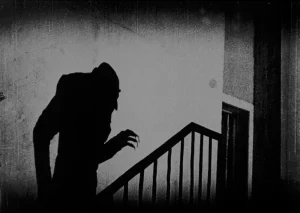
Vampires have long existed in the folkloric imagination, spanning cultures and continents, but our current cultural icons can find their origins in Eastern European folklore. These vampires were often reanimated corpses, bloated, stinking, and cold to the touch. So, when did all this change?
The advent of the literary vampire in the early 19th century with the publication of The Vampyre (1819), brought about some dramatic and long-lasting changes. Suddenly, vampires were rich and charismatic. But I would be remiss to tell you that the literary vampires of the 19th century were a uniform terror. The vampires of Carmilla (1872) and The Vampyre (rich, charming, beautiful) were very different from Dracula (1897) (rich, ghastly, and foreign). And Dracula is very different from the vampires of today. The remarkable longevity of the vampire comes partly from its adaptability over the centuries.
So, what caused the vampire to keep changing?
II. From Monster to Character
Lord Ruthven of The Vampyre has a name, social status, attractiveness, and personality. He looks almost completely human and easily integrates into British high society. And yet, he is a monster, which the young Aubrey soon comes to realize.
Lord Ruthven’s high social status – he’s an aristocrat – allows Polidori to complicate the relationship between the vampire and Aubrey. Aubrey is at first enchanted with the Lord, but those feelings soon turn to disgust as he observes the Lord’s salacious and corruptive behavior. He is able to use his social status and relationship with Aubrey to swear him to secrecy regarding his vampire nature (which Aubrey is unaware of at the time) for a full year.
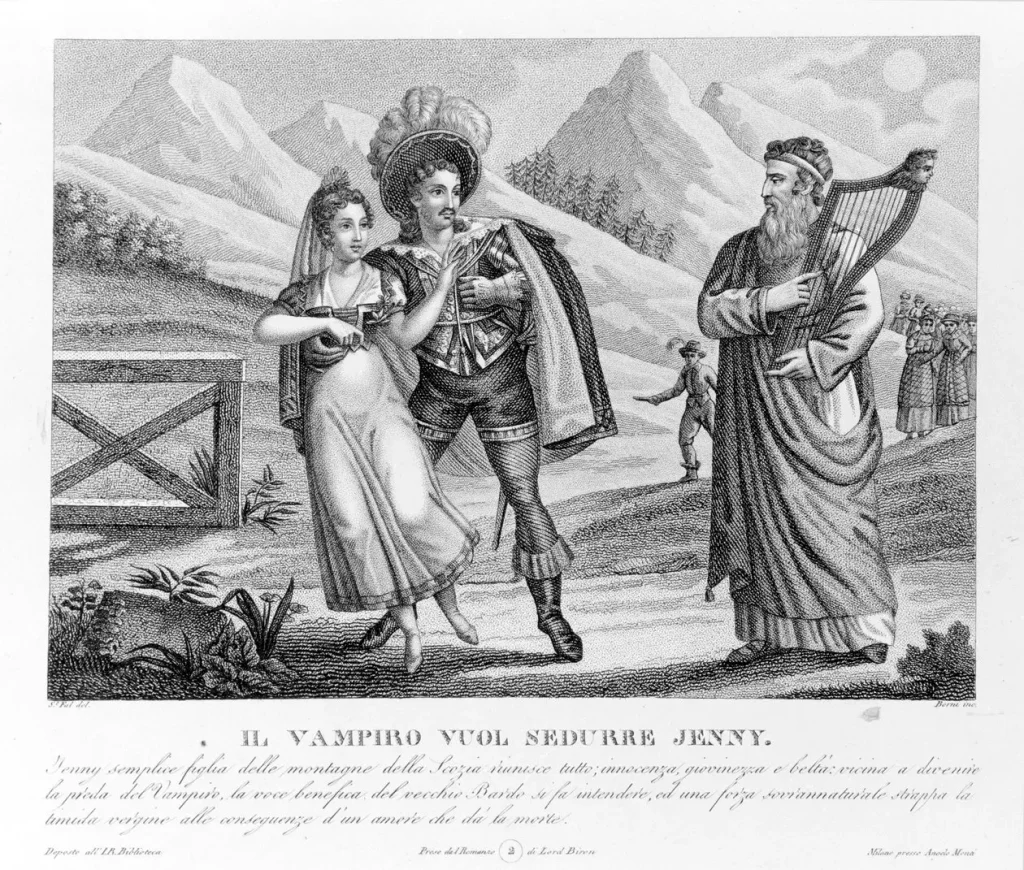
As the story progresses, Lord Ruthven comes back with a vengeance, and Aubrey is forced to watch the reanimated Lord wreak havoc in his personal life without recourse because of the oath he swore to him as he was dying.
When he first sees the reanimated Lord Ruthven, Aubrey wants to warn everyone of his monstrous nature, but not only is he bound by the oath he made, he realizes that due to Lord Ruthven’s power and status, no one would believe him.
“But even if he were to break his oath, and disclose his suspicions, who would believe him?”
Lord Ruthven is keenly aware of the social conventions of contemporary British society and skillfully exploits them to his own violent ends. At every turn, Aubrey hears a haunting reminder of the oath that he swore which solidifies the power of his vampire tormentor, “Remember your oath.”
Contemporary social conventions are further exploited when Aubrey rushes to break up the wedding of his sister to Lord Ruthven.
“When on the staircase, Lord Ruthven whispered in his ear—”Remember your oath, and know, if not my bride today, your sister is dishonoured. Women are frail!.”
He is deeply aware of the impact a failed marriage would have on a woman’s reputation and subsequently her mental health and uses this to threaten Aubrey into continued silence.
What is remarkable about this story is not that Lord Ruthven can pass as human, but that he can exploit the very social conventions that are supposed to distinguish the civilized from the uncivilized. Lord Ruthven violates social conventions, encouraging moral corruption and depravity. But what makes him especially terrifying is his adeptness at manipulating contemporary social conventions to his own violent ends.
III. The Vampire Becomes Seductive
The Victorian Era (1837-1901) saw the consolidation of distinct social spheres for men and women. These distinct social spheres included a plethora of gendered stereotypes for upper-class Victorian women, that they are familial, chaste, and innocent. At the same time, 19th century gothic literature increasingly associated vampirism with eroticism, temptation, and bodily violation. Carmilla boldly disrupts Victorian expectations of femininity by being an active object and agent of desire for her female victim.
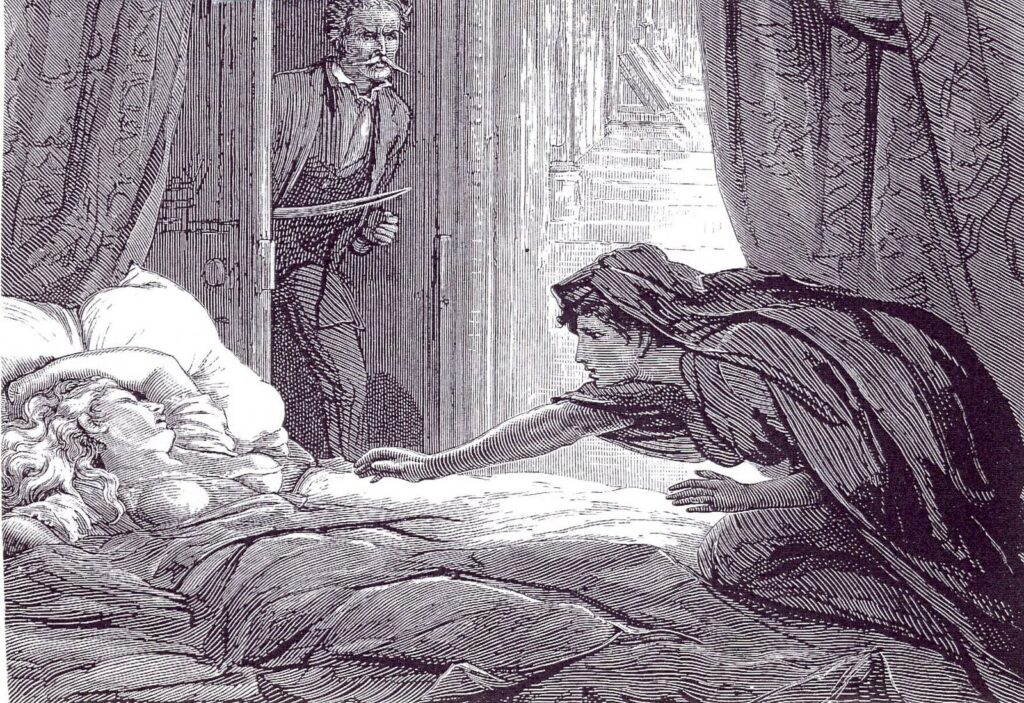
In Carmilla, the relationship between Laura and Carmilla is extremely sensual. Carmilla sweetly sighs, caresses, and kisses Laura, who struggles to understand her own feelings about Carmilla’s affection. Meanwhile, the men in Laura’s life take a medical approach to understanding and ascribing the origins of her homoerotic behavior.
“The vampire is prone to be fascinated with an engrossing vehemence, resembling the passion of love, by particular persons… But it will, in these cases, husband and protract its murderous enjoyment with the refinement of an epicure, and heighten it by the gradual approaches of an artful courtship. In these cases it seems to yearn for something like sympathy and consent.”
Thus, we see the men reinforce patriarchal norms about women’s desire and same-sex desire through the medicalization of Carmilla’s behavior, reframing it as a “pathological contamination” (John & Joshi, 8). In doing so, they assert the “unnaturalness” of female desire and the need for it to be “cured”. By assessing and ascribing the nature of the female vampire, the male characters are able to reassert dominance over and eventually destroy the physical manifestation of Victorian society’s gender-related anxieties.
Carmilla is a story told by the survivor after the fact. Laura remembers an experience that combines attraction, affection, fear, and disgust. And in Laura’s retelling of all that happened, she constantly mentions her warring emotions.
“I experienced a strange tumultuous excitement that was pleasurable, ever and anon, mingled with a vague sense of fear and disgust. I had no distinct thoughts about her while such scenes lasted, but I was conscious of a love growing into adoration, and also of abhorrence. This I know is paradox, but I can make no other attempt to explain the feeling.”
As the story concludes, Laura admits that she still thinks of Carmilla, and her feelings are still confused. Despite the medicalization of Carmilla’s behavior and desire by the male figures in her life, Laura continues to feel conflicted, expressing both desire and fear.
“and to this hour the image of Carmilla returns to memory with ambiguous alternations—sometimes the playful, languid, beautiful girl; sometimes the writhing fiend I saw in the ruined church; and often from a reverie I have started, fancying I heard the light step of Carmilla at the drawing room door.”
As John and Joshi argue, what makes Carmilla so terrifying is that she “collapses several Victorian binaries: innocence and corruption, passivity and agency, affection and violation” (page 8). Carmilla outwardly appears to be innocent and good (not sparking the suspicion of Laura and her father until the very end) but cries out at hearing funeral hymns (perhaps a hint at her corrupted nature) and is never seen praying. Carmilla’s affection is both compelling and predatory, masking the fact that she is actively draining Laura’s life force.
“I often wondered whether our pretty guest ever said her prayers. I certainly had never seen her upon her knees. In the morning she never came down until long after our family prayers were over, and at night she never left the drawing room to attend our brief evening prayers in the hall.”
Carmilla’s threat, unlike many of her predecessors, is not only violent, but also deeply emotional and passionate. Not only does she drain the life force of her victim, but she also actively expresses and pursues her homoerotic desires.
IV. Dracula and the Consolidation of the Vampire
Dracula is a synthesis of many characteristics that had already appeared in earlier 19th century vampire literature. He is wealthy, consumes the blood of others, is immortal, and poses a threat. But Dracula also brings something new to the vampire literary tradition. He threatens national boundaries, gender boundaries, and sexual boundaries. And unlike Carmilla and Lord Ruthven, he is old (ancient even), ghastly, and a stranger.
“We are in Transylvania; and Transylvania is not England. Our ways are not your ways.”
Carmilla aspired to see herself in a friend, cultivating a strong emotional bond with Laura (Nina Auerbach). Lord Ruthven and Aubrey embarked on a long journey together as companions. Dracula, on the other hand, does not seek companionship with Jonathan Harker and emphasizes the difference between Harker (and England) and himself. Thus, Dracula moves away from the vampire as companion trope to something strangely different, vampire as foreign Other.
“Is it a wonder that we were a conquering race.”
Dracula was written during the decline of the British Empire, and this decline was often reflected in Victorian literature (e.g. The War of the Worlds and The Time Machine by H.G. Wells, The Mark of the Beast by Rudyard Kipling, etc.). Arata argues that Dracula presents the “pervasive narrative of decline, a narrative of reverse colonization.” (Arata 623). In his analysis, Dracula is a ghastly mirror of the British empire, gaining intellectual mastery of a foreign (English) culture before traveling to its capital (London) and gaining physical mastery over Harker and his companions.
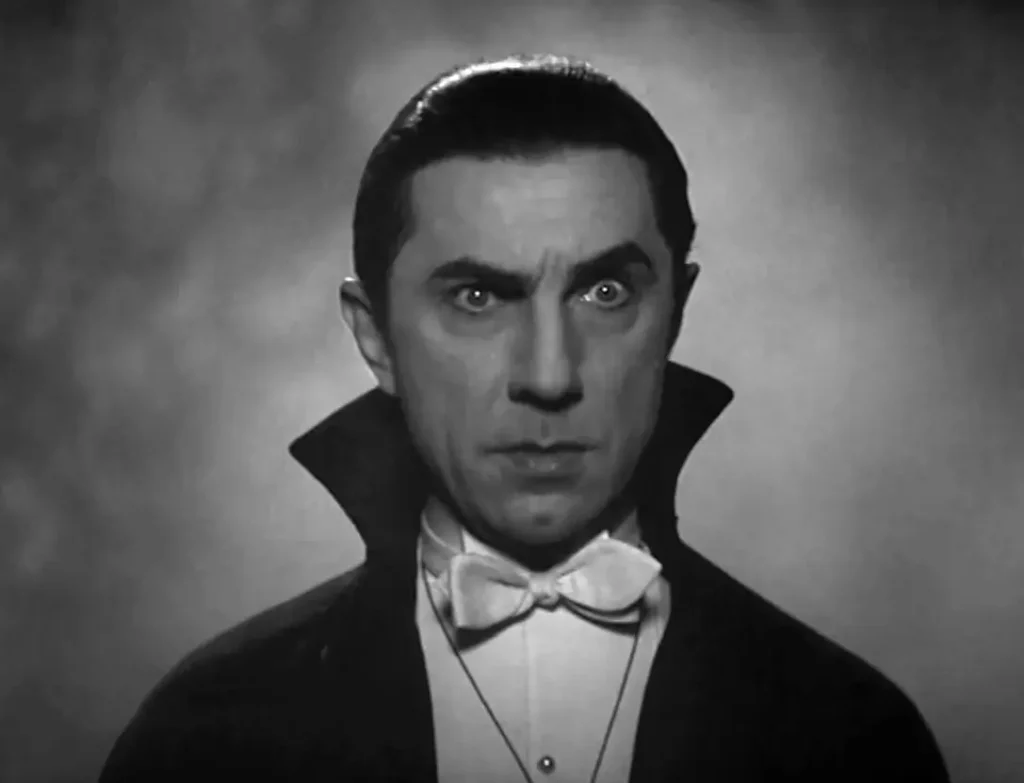
Carmilla is popularly seen as a representation of Victorian anxieties about sexuality and gender. Dracula can also be interpreted as representing Victorian fears of English virility and power. Not only does Dracula attack the virtuous Mina, but he turns Lucy, transforming her into a hypersexualized vampire. Lucy goes from being a virtuous, marriage-ready woman, to a predatory sexual monster.
Dracula emasculates Jonathan, not only by biting him and sucking the life force out of him, but by claiming ownership of him. When Dracula walks in on his three female vampire underlings toying with Jonathan, he lashes out saying:
“How dare you touch him, any of you? How dare you cast eyes on him when I had forbidden it? Back, I tell you all! This man belongs to me!”
Later on in the novel, Dracula overpowers Jonathan, forcing him into a stupor so that he can force his wife to drink blood from his chest. Van Helsing arrives during the act and is able to stop the Count while Jonathan remains dazed and unaware of what is going on around him. Over and over, Jonathan is overpowered, unable to protect himself or his wife from a serious threat.
“His right hand gripped her by the back of the neck, forcing her face down on his bosom. Her white nightdress was smeared with blood, and a thin stream trickled down the man’s bare breast which was shown by his torn-open dress.”
Dracula is an especially rich symbol, representing fears of invasion and the foreigner, changing gender roles and sexual anxiety, and even anxieties about modernity, depending on who you ask. His cultural influence was so large that it created the basic vocabulary that later vampire fiction follows. In Dracula we see a synthesizing and concretization of the literary vampire.
V. The Vampire Leaves the Gothic Castle
In the 20th century, we start to see a radical transformation of vampires in literature. They became increasingly embedded in everyday society. Richard Matheson’s I Am Legend (1954) represents a popular break from standard vampire treatment in fiction. In the novel, Robert Neville is the last human on earth and is taunted daily by a band of blood-thirsty vampires. He spends his days killing vampires as they sleep, and his nights ignoring their taunts and jeers. What makes I Am Legend such a phenomenal work of vampire fiction is that we see a human question the inherent monstrosity of the vampire.
“He [the vampire] was anathema and still remains anathema. Society hates him without ration. But are his needs any more shocking than the needs of other animals and men? Is the vampire so bad?”
In a reversal of traditional vampire narratives, the human is the minority, while the vampire is part of the dominant population. Robert constantly reflects on his loneliness and isolation. As the last human on earth, he questions the morality and utility of killing vampires. By positioning Robert as the sole human survivor of a vampiric virus, Matheson calls into question the designation of monstrosity. Is monstrosity inherent or is it a designation – imposed by whom? As the long days of killing vampires continue, Robert asks:
“Well, what else can I do? He asked himself, for he still had to convince himself he was doing the right thing.”
The categories of human, monster, and normal blend and become unstable as Robert’s (and the reader’s) perspective changes. Robert eventually meets a young woman named Ruth and drags her back to his home. While only together for one night they talk about the vampire virus, his theories, and his experiments. Ruth’s reaction is clearly disapproving, and he’s confronted with a totally alien thought, what if I’m wrong? Near the end of the novel, Robert is abducted by the vampires who represent the new world order. As he waits for his state-sanctioned death by the nascent vampire community, he looks at the terrified faces of the vampires looking up at him and realizes that he’s on the other side. He is the monster.
“Robert Neville looked out over the new people of the earth. He knew he did not belong to them; he knew that like the vampires, he was anathema and black terror to be destroyed.”
VI. The Vampire Becomes the Protagonist
In Anne Rice’s Interview with the Vampire (1976), the story is told from the point of view of the vampire Louis. Suddenly, vampires are not monstrous, others described from the point of view of a terrified human. Instead, we get to see the world through the eyes of a vampire, experiencing his guilt, happiness, desire and uncertainty from within. Louis experiences introspection and emotional struggle. As readers, we can sympathize with him because we see the world through his eyes – Louis is the narrative authority. We watch him struggle with his faith, mortality, vampire nature, and even his mental health. Anne Rice ushered in a huge shift in how we treat vampires in fiction, turning them from a monstrous Other, to a misunderstood and sympathetic monster.
Louis may look inhuman with “utterly white and smooth [skin], as if he were sculpted from bleached bone,” but the inner turmoil he faces as he reckons with his nature is purely human. Louis struggles with guilt over the suicide of his younger brother and with his desirous feelings towards the male vampire Lestat. Louis’ two vampire companions, Lestat and Claudia, relish in the kill, playing with their prey like a cat toying with a mouse before the kill. Louis increasingly feels isolated in his vampire home because he struggles with killing and the guilt that follows, which is heavily influenced by his Catholicism. He eventually turns to feeding on rats and stray cats, instead of giving in to what he sees as his new monstrous nature.
“‘I know that well enough!’ I said. ‘But what is it that is our nature! If I can live from the blood of animals, why should I not live from the blood of animals rather than go through the world bringing misery and death to human creatures!’
But does this make him less of a monster? According to Lestat, his maker, Louis’ actions are unnatural and an attempt on Louis’ part to retain something that he no longer has, mortality. And Lestat’s response to Louis’ tirade – “‘Does it bring you happiness?” is revelatory. Yes, Louis can live off of rats and alley cats, but should he? Will that make him fulfilled? Lestat never rejects that vampires are monsters, but that doesn’t mean they shouldn’t enjoy themselves and be happy.
Rice firmly highlights the difference between her modern vampires and the vampires of old. When Louis and Claudia go to Europe in a search for other vampires, they find what amounts to “sub-human zombies” with little capacity for reasoning or complex thought (Galina Devedjieva, 419).
“We had met the European vampire, the creature of the Old World. He was dead.”
Louis and Claudia went to Eastern Europe searching for sage ancestors and the secrets of their existence. But instead, they are only greeted by “mindless corpses.” Their first encounter with one of these vampires quickly turns violent and Claudia and Louis struggle to kill it. As they stare at the dead body with its huge bulging eyes, putrid, leathery skin, and rotting rags, they realize for the first time that they might be the only intelligent vampires on earth. Louis and Claudia eventually run into other vampires in Eastern Europe but only observe them from afar before quickly deciding to leave for Paris, where Lestat lived before moving to the U.S.
“And her eyes… they were mindless, empty, two pools that reflected the moon. No secrets, no truths, only despair.”
Louis and Claudia see themselves as being above the Eastern European vampire because of their ability to have complex emotions and high-level thinking. They are monsters with interiority who occupy a space of emotional complexity where the old vampires are only empty blood-thirsty creatures.
As we move into the 21st century, vampires continue to occupy domestic space, experiencing romantic love, moral responsibility, ordinary routines, and existential questions. But vampires transform from being monstrous, but sympathetic protagonists, to almost human. By struggling with these everyday concerns while also struggling with the very nature of being a vampire, vampires in fiction occupy an uncomfortable space between human and monster, self and Other, and desire and danger. 21st century vampires (à la Twilight) have become so human (attending school, drinking human blood alternatives, occupying space in domestic life) that readers may begin to wonder, what exactly makes a vampire a monster?
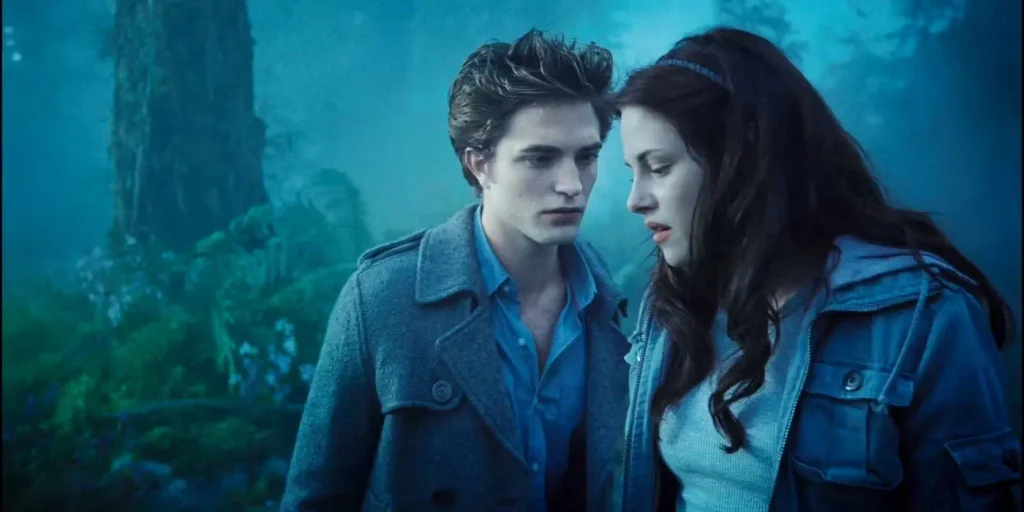
If a vampire doesn’t drink human blood, is it still a monster? This question is approached in Twilight where the main character Bella Swan falls in love with a vampire, Edward Cullen. They attend school together, do domestic tasks together, have sex, and even have a child, all while Bella is human.
Bella and Edward constantly have arguments about the dangerous nature of their human-vampire relationship, with Edward fearing that other vampires, and even he himself, might hurt her. But Bella is so enamored with Edward and his vampire life that she downplays the threat. She often daydreams about what she would look like as a vampire – beautiful, powerful, and no longer the awkward teenage girl that she is. Edward’s life is desirous, negative side effects be damned. And really, what are the negative pitfalls of being a vampire when you can be a vegetarian vampire and live among humans?
VII. Why Does the Vampire Never Truly Die?
Vampires embody contradiction, occupying a space between seemingly rigid categories (i.e. alive and dead, human and monster, desirable and dangerous, individual and outsider, etc.). When these boundaries become contested, the vampire becomes a way of exploring that instability. This makes the vampire easy to manipulate and reconstruct based on the needs of the current society. In folklore, vampires were used to explain disease, death, and loss. Lord Ruthven exposed contradictions within civilized society. Carmilla unsettled the boundaries around femininity, sexuality, and desire in Victorian England. Dracula embodied anxieties about foreignness, invasion, and imperial decline at the end of the Victorian era. I Am Legend destabilized the distinction between human and monster. Interview with the Vampire explored the relationship between monstrosity, consciousness, and morality. And contemporary vampire fiction explores the possibility of reconciling vampirism with ordinary human life.
VIII. Conclusion
The vampire has survived so long in fiction because there is no single definitive vampire.
Early vampire stories generally ask what happens when society (usually represented by an individual) encounters a threat. Even so, at the advent of the literary vampire, vampires such as Lord Ruthven, Carmilla, and Dracula all represented different fears and had different characteristics. Modern vampire fiction has slowly moved away from this positioning of the vampire as a monster and inherent threat. Instead, modern vampire fiction asks us, what happens when we experience the world as a vampire?
The history of the literary vampire is not simply a history of a monster becoming less frightening, it is the history of a monster becoming increasingly capable of reflecting our own humanity back at ourselves.
Every generation gets to reinvent the vampire to fit its needs. What does the modern vampire say about us?
Previously in the Vampire Archives
In my first post of the Vampire Archives, I discussed the folkloric origin of vampires. Read it here: Before Dracula: The Origins of the Vampire.
In my second post of the Vampire Archives, I discussed the literary origin of vampires. Read it here: Before Dracula: The Birth of the Literary Vampire
For an overview of the Vampire Archives series and what to expect, check out my introductory post here: The Vampire Archives: An Introduction to My Vampire Literature Curriculum.