“To all the things we haven’t done, the things we should have done, and the things we won’t do.”
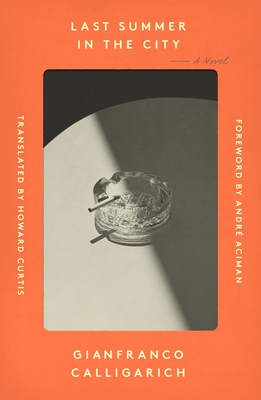
Last Summer in the City by Gianfranco Calligarich, which was only published due to Natalia Ginzburg’s influence, transports us to 1960s Italy, where the specter of WWII and the subsequent economic boom loom largely in the shadows. Our main character Leo rebuffs societal norms – while his friends are obsessed with moving upwards in life (graduation, marriage, etc.), Leo has no such desire. For him, life has no purpose – and his life in particular, one full of avanzo e.g. “leftovers,” only deepens his sense of malaise. And his inability to find meaning stems from inhabiting the emotional and cultural leftovers of postwar Italy.
The Sea as Leo’s Only Refuge
The novel opens with Leo talking to us about his philosophy on life while he stares into the sea, which serves as a source of physical and spiritual redemption. Calligarich, of Slovenian ancestry, can trace his ancestors back to the seaport of Trieste and in an interview said that his extended family “feels drawn to Trieste, dreams Trieste, feels Trieste” and ultimately claims to “belong to no place but Trieste.” Thus, Leo’s affinity for the sea can be said to be autobiographical, a reflection of the author’s own ancestral relationship to the sea. The sea lures Leo to Rome with its siren song; He takes any opportunity to go to it, finding a comfort in it that he cannot find in companionship.
When his Slavic grandfather is on his deathbed, he asks his son (Leo’s father) to bring him some seawater, thus reinforcing the spiritual nature of the water. This is where we see a hint of Leo’s general philosophy on life for the first time. Leo and his father go on the journey to the sea together and return with the requested water, only to find the grandfather is unconscious. Leo calls this the most “pointless” trip to the sea of his life. Despite the effort that his father put into honoring his grandfather’s final request, Leo can’t see past the futility of the exercise as his father dabs seawater on his grandfather’s unconscious face.
Living on the Leftovers of Postwar Italy
As the novel progresses, Leo realizes that his life is not his own and is full of “leftovers” – he occupies his couple friends’ apartment while they’re in Mexico, his jalopy he bought from them, his friends use their connections to get him odd jobs, and his love interest, he realizes, is only his when she’s “possessed” by someone else. These realizations lead to Leo genuinely trying to change, but his attempts are met with failure on a comical level.
His best friend Graziano, perhaps best encapsulates the general feeling of “leftovers” when he says,
“We were an ugly memory… and we just had to be content with the leftovers.”
At first, Leo disagrees with his friends’ tirade, but then he reflects on his father and how he came back from WWII a changed man, and accepts Graziano’s words as truth. Leo’s generation is not the inheritor of an Italy experiencing the post-war miracle – that would be the pennywhistle rebels that Graziano rails against. Instead, Leo and his peers have to be content with the dredges of a society that, in its exhilaration in moving past the trauma of WWII, has largely forgotten them.
Where the Novel’s Central Romance Falls Short
The central relationship in this novel is that between Leo and Arianna, his love interest. Arianna appears like a hurricane, histrionic, fragile, and ethereally beautiful. Their relationship goes up and down as Leo navigates life in the Eternal City. Unfortunately, the relationship between Leo and Arianna was not convincing. Arianna felt like an Italian version of the manic pixie dream girl, who only existed to help the main character process his own internal conflict.
I was actually more touched by Leo’s relationship with his father, which was subtle, emotional, and dynamic. Despite them having almost no dialogue (as opposed to Leo and Arianna), I found myself wanting to see more of their relationship.
A Novel About Meaning—And It’s Absence
The novel takes off with Leo getting on a train for Rome and ends with him taking a train back to Rome. The cyclical nature of these events mirrors his life. Leo goes back and forth on whether he should indulge in alcohol, his relationship with Arianna, and whether he should strive for a better life. Many of these struggles are left unresolved by the novel’s end.
When Leo takes a train home to Milan to visit his family near the end of the novel, seeing the contented look on his parents’ faces in the distance, he turns around and heads back to Rome. As he’s sitting on the train he realizes he’s moving further and further away from having a meaningful life.
“The sadness only hit me when the train pulled out and I realized that if it had headed in another direction, any direction, it would have been all the same to me.”
Throughout the novel, Leo rejects ritual, relationships, and work, because they do not naturally give his life meaning. The sea remains the only constant, asking nothing of him. At the end of the novel, Leo ends up right where he started, alone, staring out into the sea.