Introduction
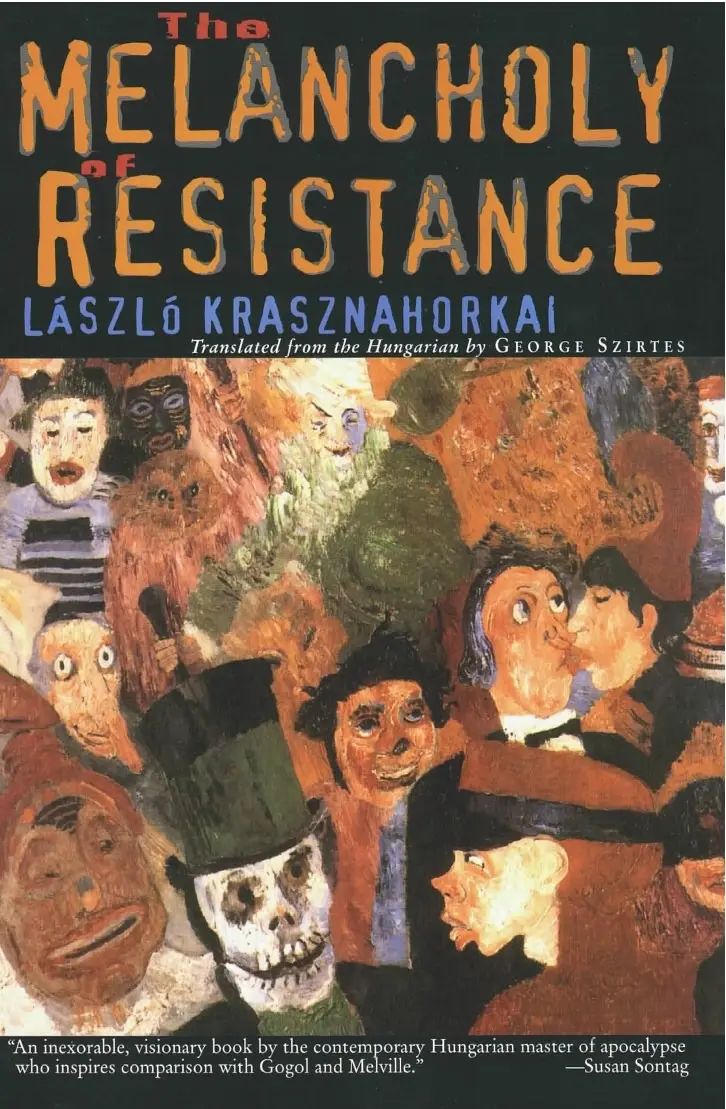
In the apocalyptic and often melancholic fiction of László Krasznahorkai, winner of the 2025 Nobel Prize in Literature, long, winding sentences stretch across the page, seemingly gathering force as they go. His translator George Szirtes famously described his prose as “a slow lava flow of narrative, a vast black river of type.” First published in 1989, “The Melancholy of Resistance” offers one of the clearest demonstrations of that style, turning the arrival of a strange circus in a small Hungarian town into a bleak meditation on how quickly social order can dissolve into chaos, mob rule, and authoritarian control.
What Is The Melancholy of Resistance About?
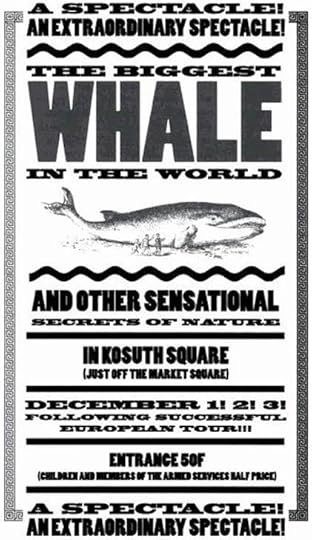
A small Hungarian town is in a state of decay both socially and materially. The novel starts with Mrs. Plauf, an uptight member of the petit bourgeois, who is on her way home by train. While waiting at the station, she ruminates on a series of recent, mysterious events which are referred to by the general population as “omens of…the coming catastrophe.” During the train ride, she is almost assaulted, an incident which further exacerbates her fears of the coming “collapse into anarchy” and the broader decay of society. When she finally arrives in her hometown, the streetlights are not working, and the streets are covered in trash. Through the gloom she notices a sign advertising the arrival of a circus boasting the largest whale in existence. The arrival of this circus will set off a chain of events which can only be described as pure chaos.
The novel features an eclectic cast of characters who dominate the narrative with their eccentricities: the quasi-fascist Mrs. Eszter, who schemes to reshape the town according to her vision; her sickly husband, a former musician resigned to the margins of society; and Valuska, the postman and town fool, who contemplates the cosmos in quiet wonder. As the story unfolds, each character retreats into their own coping mechanism—whether it be ambition, nostalgia, or imagination—to impose a sense of order on a chaotic world. These attempts frequently collide, producing clashes that are both absurd and revealing, reflecting Krasznahorkai’s exploration of the human condition, societal stagnation, and the tenuous balance between order and anarchy.
Themes and Symbolism in The Melancholy of Resistance
Chaos and anarchy: The arrival of the circus and the mysterious and foreboding Prince serve as a conduit to exploring humanity’s response to unbridled chaos and anarchy. The Prince, whose enigmatic voice we hear through an interpreter, is able to control a group of his devotees who quickly turn to rioting, looting, and murder.
Fascism & Tyranny: “The Melancholy of Resistance” explores how authoritarianism arises from societal weakness, with characters like Mrs. Eszter seizing power amidst the chaos.
Commanding and abrasive, Mrs. Eszter enters the story like a hurricane, leaving a trail of disruption in her wake. Ambitious and visionary, she champions a social renewal campaign, only to face relentless opposition from the townspeople wary of upheaval. She scathingly critiques the upper echelons of society, calling them “a fine society of parasites, saturated by their own sense of self-worth…” (p. 38). Unlike her neighbors, who fear change, Mrs. Eszter embraces it as a path to transformation.
She is keenly aware of the existential unease lurking beneath the surface of everyday life and the fragility of societal structures.
“…Mrs. Eszter saw straight to the heart of their opposition, understanding that their impotence and craven servility sprang from an unreasonable, though, to them, justified, fear of all enterprise that aimed at general renewal, a renewal which, to them, might look like general decay, for in all passionate espousals of the new, people were liable to detect traces of an equally passionate drift towards chaos, and – quite rightly – suspect that the powers unleashed, instead of protecting that which was irrecoverably dead and buried, would smash it to pieces in the good cause of replacing the featureless boredom of their selfish lives with the ‘elevating passion of communal action’” (p. 38).
Mrs. Eszter is a mastermind of manipulation, showing extreme cunning in the face of indifference and servility from the townspeople. As the story progresses, we gain a better understanding of Mrs. Eszter’s role in the chaos that has overrun the town and how it aligns with her vision of the future–a future where she is in control.
She faces little resistance from the local population during the novel’s two-week span, largely because of their pervasive fear and unease, which Krasznahorkai conveys with his characteristic, tense prose. Superstitious and obsessed with omens, the townspeople quickly resign themselves to passivity, allowing the world’s chaos to dictate their actions—or inactions. Valuska stands out as one of the few who recognizes the danger in this resignation and confronts it, however futilely.
“Contrary to what anyone might think, it had not escaped Valuska’s notice, the evidence being so readily available, that everyone he met was preoccupied by the notion of ‘the collapse into anarchy’, a state that, in the general opinion, was no longer avoidable. Everyone was talking about ‘the unstoppable stampede into chaos’, the ‘unpredictability of daily life’ and ‘the approaching catastrophe’ without a clear notion of the full weight of these frightening words, since, he surmised, this epidemic of fear was not born out of some genuine, daily increasing certainty of disaster but of an infection of the imagination whose susceptibility to his own terrors might eventually lead to an actual catastrophe, in other words the false premonition that a man who had lost his bearings might succumb to once the inner structure of his life, the way his joints and bones were knit, had loosened and he carelessly transgressed the ancestral laws of his soul–if he simply lost control of his undemeaningly ordered world” (p. 96-97).
Conclusion
Many might be quick to pin this bleak and pessimistic view of society on the ills of communism given the author’s background growing up in communist Hungary. However, I believe that this view would not be doing this novel, or many of Krasznahorkai’s other works justice. “The Melancholy of Resistance” delivers a starkly universal message about the fragility of society and the ways humans confront the chaos lurking beneath the surface of order.
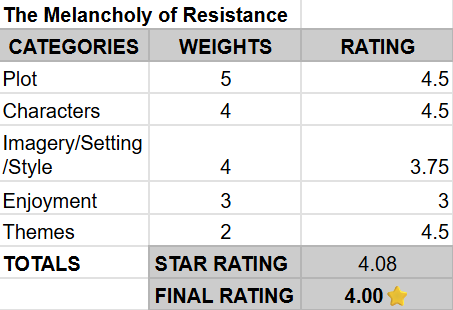
Rating: 4/5 stars.
Related Reviews
Satantango – A hypnotic masterpiece that examines hope, manipulation, and human despair in a decaying Hungarian village.